Material Specification: D2 (HRC 60)
D2 is a high-carbon, high-chromium cold-work tool steel. Its chemistry yields a high volume fraction of chromium-rich carbides (M7C3 type) that confer abrasion resistance on abrasive tissue substrates.
The typical as-tempered hardness for D2 falls in the HRC 58-62 band. HRC 60 sits within this window and is the target for this bed-knife grade. D2 exhibits secondary hardening near 500 °C tempering due to fine carbide precipitation.
| Property | Value |
|---|
| Density | approximately 7.7 g/cm³ |
| Elastic modulus | approximately 200 GPa |
| Thermal conductivity | approximately 20–25 W/(m·K) (low) |
| Hardness target | HRC 60 (within HRC 58-62 window) |
| Carbide type | M7C3 (chromium-rich) |
The low thermal conductivity of D2 is a contributing factor to edge-heat accumulation at high web speeds, which becomes a design constraint on the edge preparation covered in the next section.
Manufacturing Process: Precision Grinding
The bed-knife production sequence is anchored to precision grinding as the final tolerance-controlling operation, with the metallurgical state locked in before grinding begins.
Process sequence
- Austenitization at 1000-1050 °C, followed by air or oil quench
- Double temper (transformation of retained austenite)
- Inter-process datum: post-temper hardness verification at Rockwell C, target HRC 60, is mandatory before precision grinding
- Precision grinding with distortion allowance (approximately 0.1-0.3 mm per side) reserved in stock
- Edge preparation (micro-hone) and clearance-angle set
Vacuum or controlled-atmosphere furnace is used to prevent surface decarburization, which would soften the cutting edge and shorten service life.
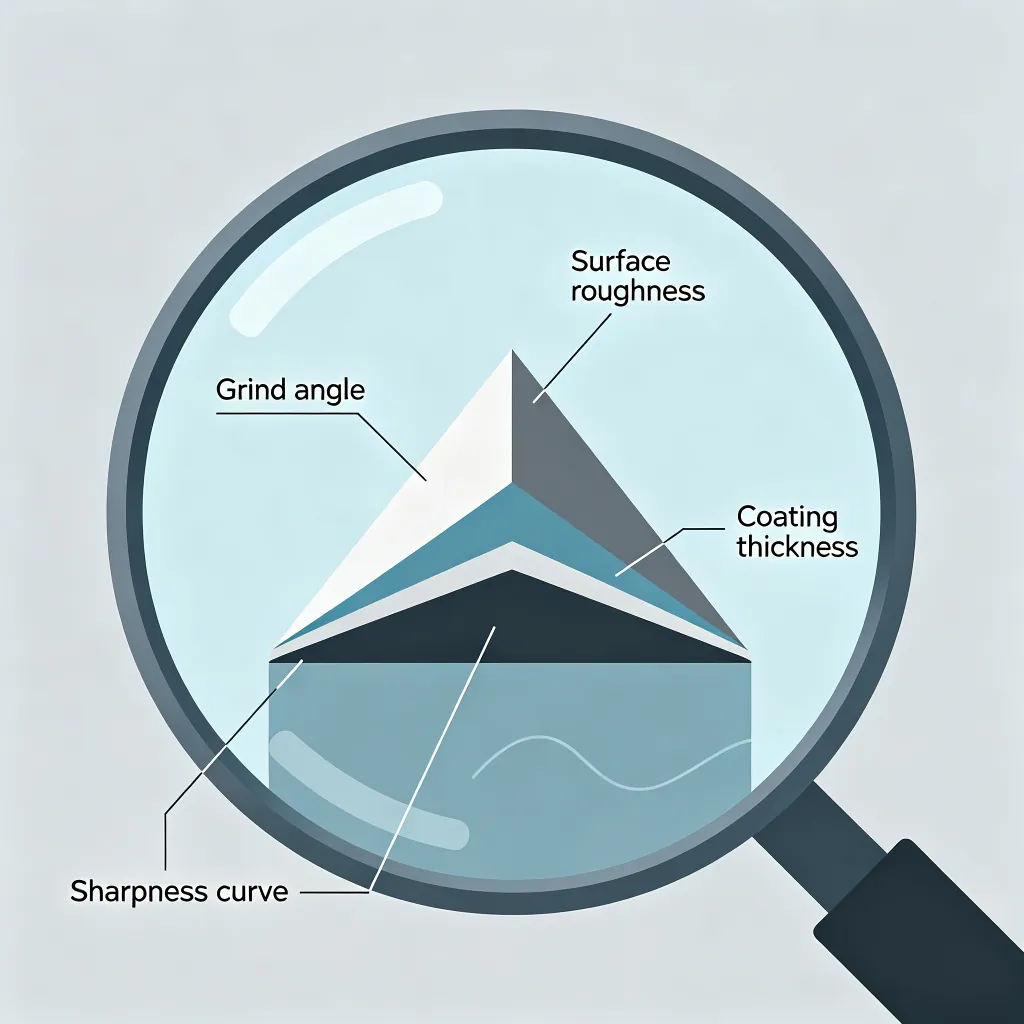
Edge Geometry for 1200 m/min Tissue Lines
The edge geometry —not the steel grade —is the dominant variable on high-speed tissue converting lines.
Failure mode at sharp edge
At 1200 m/min on 4-ply tissue, edge temperature reaches approximately 180 °C. A sharp edge (micro-hone under 5 μm) is susceptible to thermal-fatigue micro-cracking at this temperature. The failure mode is edge chipping on a sub-millimetre scale, after which burr accelerates. This is documented, not theoretical.
Geometry specification
| Parameter | Value |
|---|
| Micro-hone | 15 μm |
| Clearance angle | 18° |
| Reference web speed | 1200 m/min (4-ply tissue) |
| Reference edge temperature | approximately 180 °C |
| Burr control target | ≤ 50 µm |
Documented outcome
A 15 μm micro-hone combined with an 18° clearance angle extended service life from 11 days to 34 days at 1200 m/min on 4-ply tissue —with no steel change and no price change. The grade (D2, HRC 60) was never the problem; edge preparation was.
Tolerance control
Bed-knife flatness and parallelism across the cutting length directly affect slit-edge quality and downstream converting tolerances.
Quality and Traceability: ISO 9001:2015
The bed-knife production operates under ISO 9001:2015 with material traceability per §8.5.
Traceability chain
- Incoming steel heat —linked to mill certificate (chemical composition, incoming hardness)
- Heat-treatment batch records —retained as objective evidence of metallurgical specification
- Final dimensional and edge-prep inspection records —reference back to material heat number for full lot traceability
Engineering records as evidence
Service-life data on specific lines (operating speed, substrate, days) is engineering record evidence that supports process-control decisions. The 11-to-34-day transition documented on the 1200 m/min line is one such record.
FAQ
Q: Why does a sharp D2 edge chip on a 1200 m/min tissue line? A: At 1200 m/min on 4-ply tissue, edge temperature reaches approximately 180 °C. A sharp edge (micro-hone under 5 μm) is susceptible to thermal-fatigue micro-cracking. The failure mode is sub-millimetre edge chipping, followed by accelerated burr formation.
Q: Does changing the steel grade fix edge-chipping on tissue lines? A: No. The 1200 m/min case study on 4-ply tissue showed that 15 μm micro-hone plus 18° clearance angle (with D2 at HRC 60 unchanged) extended service life from 11 to 34 days. The steel grade was not the variable.
Q: What clearance angle should a tissue bed knife have? A: For high web speed (1200 m/min) on tissue, 18° is the documented working clearance angle in our case data. The conventional 22° clearance on a sharp edge chatters and chips; 18° on a 15 μm hone runs clean.
Q: What hardness should a D2 tissue bed knife be? A: HRC 60, which sits within the D2 typical as-tempered band of HRC 58-62. Hardness above this range risks chipping on a thin blade; below risks accelerated wear.
Q: How is the heat-treatment batch linked to the finished blade? A: ISO 9001:2015 §8.5.2 requires identification of outputs throughout production. Each finished blade’s dimensional and edge-prep inspection record references back to the material heat number, the mill certificate, and the heat-treatment batch record.
Q: Can burr height be controlled below 50 µm on tissue? A: Yes — ≤ 50 µm is the burr control target on tissue slitting, achieved by the 18° clearance angle and 15 μm micro-hone combination. Exceeding this threshold indicates either edge wear (replace) or geometry drift (regrind or scrap).