Plastics Recycling
Granulator and Shredder Rotor / Stator Knives
Engineered to cut through contamination, glass fibre and reinforced polymers. D2 and M2 HSS options, with optional TiN or CrN PVD coating to extend service interval by 2–3× on the same line.
Working principle
How the rotor-stator shear cut works
Open-rotor and closed-rotor geometries cut by impact shear, not by slicing. The geometry choice, hook angle and clearance angle are dictated by substrate, throughput and contamination class.
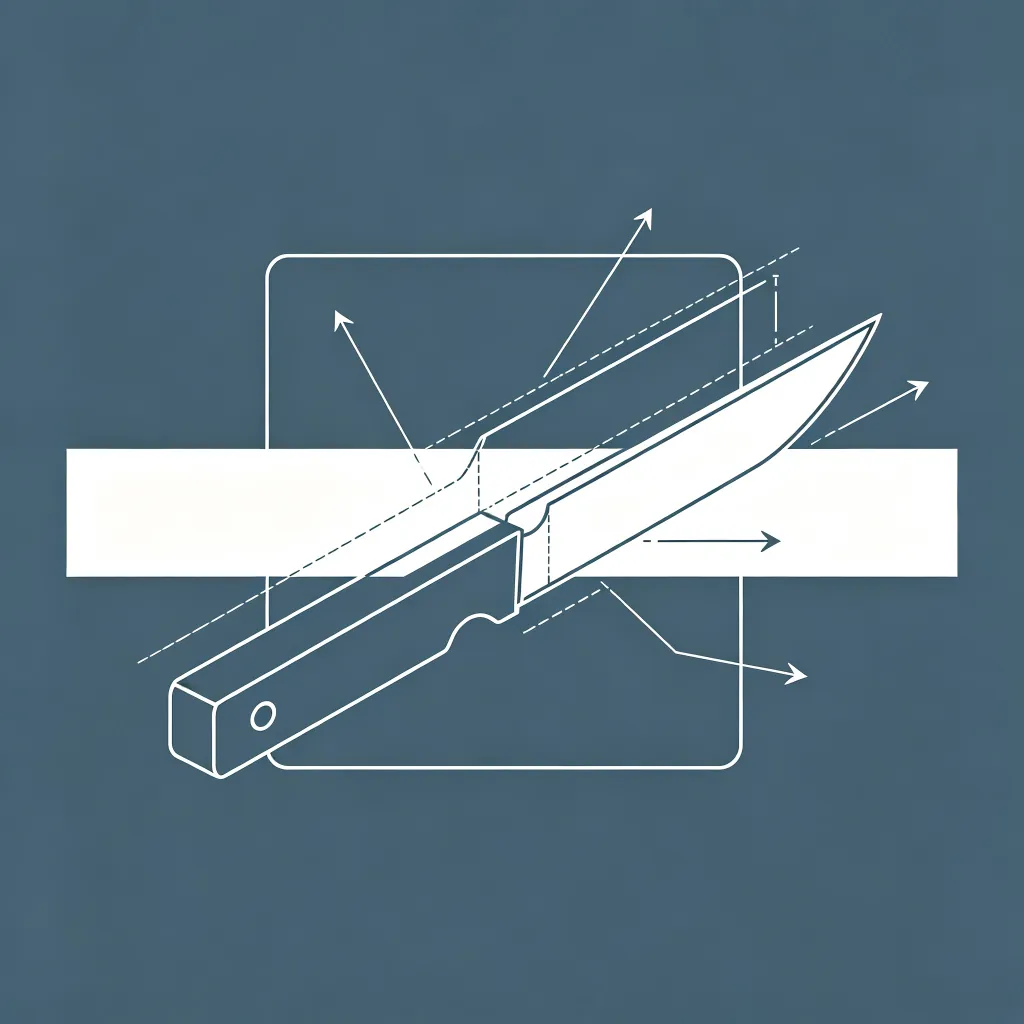
A granulator rotor carries a ring of knives rotating past a stationary bed knife. Material enters the cutting gap and is sheared by impact, not by the kind of clean slicing a slitter performs. Open-rotor (cut-and-throw) geometries push the cut product out of the cutting chamber with the same rotation; closed-rotor (scissor-cut) geometries rely on a downstream screen to size the output.
The two failure modes we see most often —micro-chipping on glass-fibre and progressive welding on sticky polymer —both trace back to the same root cause: edge preparation and clearance angle were specified for the wrong substrate family.
Open rotor (cut-and-throw)
3 or 5 blades. Lower friction, higher throughput. Best for film, fibre, low-density feedstock.
Closed rotor (scissor-cut)
3 or 5 blades + matched bed. Cleaner cut, tighter granulate. Best for rigid plastic and engineering polymer.
V-cut / claw profile
For shredders. Aggressive bite on bulky post-consumer parts and purgings.
Engineering scope
Six specification levers for plastics recycling
Recycling lines are abrasive, impact-loaded and inconsistent. Each variable below is selected against substrate, throughput and contamination class —not against the cheapest steel on the shelf.
Substrate range
PET, HDPE, LDPE, PP, PA66 and other engineering polymers, including glass-fibre reinforced grades up to 50 % GF, mineral-filled compounds, and post-consumer feedstock with contamination (paper labels, metal specks, abrasive fines).
Rotor / stator configurations
Standard 3- and 5-blade rotor sets with matching bed knives. Open-rotor (cut-and-throw) and closed-rotor (scissor-cut) geometries. V-cut and claw profiles for shredders. Knife seat and slot dimensions to OEM specification.
Material grades
D2 (1.2379 / SKD11) for general-purpose cutting, M2 high-speed steel (1.3343) for impact-loaded rotors. Hardness HRC 58–62 D2, HRC 60–64 M2. Vacuum heat-treatment with double-temper for dimensional stability.
PVD coating options
TiN, TiCN and CrN coatings per ISO 14574 extend service interval 2–3× on glass-fibre and mineral-filled feedstock. CrN preferred for high-temperature reclaim lines. Coating thickness 2— µm, applied after final grind.
Hook and clearance angles
Hook angle 8°–15° for general-purpose, 18°–22° for high-throughput reclaim. Clearance angle 2°—° rotor, 3°—° bed knife. Aggressive angles on contaminated feedstock; conservative angles on glass-fibre to limit chipping.
Tolerances and regrind
Standard ± 0.01 mm thickness, ± 0.02 mm length, parallelism 0.02 mm across the cutting edge. Up to 4 regrinds permitted on standard D2 knives before the cutting edge falls below OEM geometry. Regrind service available in-house.
Specifying granulator or shredder knives?
Send the OEM model, rotor diameter, current knife grade and the typical feedstock mix. We will return a written quote with material, hardness, coating option and expected service interval within one business day.